A Masterclass in Emotional Intelligence at 30,000 ft
Two models that explain almost every workplace conflict.

I was on an easyJet flight recently.
The weather conditions were awful, and the flight crew took the unusual step to ask passengers to completely switch off their electronic devices for take-off (rather than just asking them to put them into flight-mode).
Inevitably, a few passengers were reluctant to do this and ignored the instructions. The Head of Cabin Crew, Kiri, went down the aisle and, warmly smiling at the recalcitrant device users, said: “Could you pop your phone off for me?”
Everyone complied.

Intelligent people management
Kiri’s approach struck me as highly skilled, emotionally intelligent people management. As General Eisenhower said, “leadership is about getting other people to do what you want, and them wanting to do it.”
Passengers on a flight are likely to be stressed; some hate flying, some have been running late, some have work or personal stuff to deal with, which means a few hours offline is problematic, some have drunk alcohol, and some people just don’t like being told what to do. Put simply, the chances of drama, of resistance to authority, are high
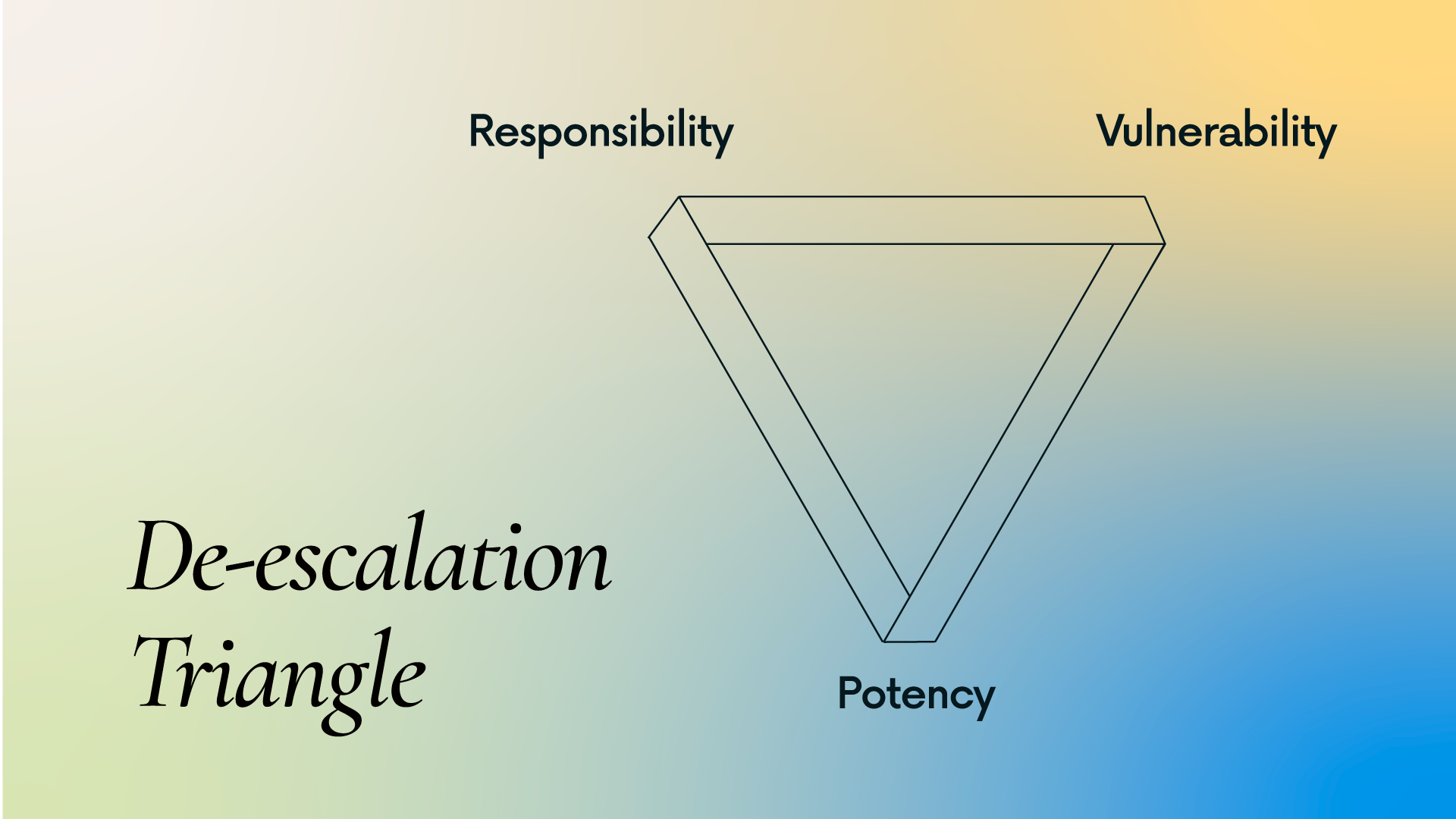
The ‘de-escalation triangle’ is a means of establishing, or reestablishing, ‘adult-to-adult’ relationship when things have descended into ‘drama’. The heightened vacillation in the drama triangle between Persecutor and Victim can become self-propelling when things are out of kilter. The de-escalation triangle is a means of calming that drama by taking away some of the threat.
Inherent in some, learnable by all
This can often feel rather formulaic and forced, a scripted set of words that includes responsibility, vulnerability and potency. But, in this example, it was entirely natural and subtle.
The responsibility was clear from the request and the context. The vulnerability was effectively yet implicitly conveyed with Kiri’s choice of the words ‘for me’, making it a personal favour rather than an authoritative demand.
‘I’m here to do a job, but can’t do it without your cooperation’ was the implied vulnerability. The potency was also contextually implied: ‘I have the power to force this, but I really don’t want to use that power.’
Kiri told me that she hadn’t been trained to use these words, she did it naturally. But then that’s why she’s good at her job and why she has progressed to being the Head of Cabin Crew. It’s a natural, unconscious capability that is inherent in some people, but learnable by all.
SPEAKERS
I was on an easyJet flight recently.
The weather conditions were awful, and the flight crew took the unusual step to ask passengers to completely switch off their electronic devices for take-off (rather than just asking them to put them into flight-mode).
Inevitably, a few passengers were reluctant to do this and ignored the instructions. The Head of Cabin Crew, Kiri, went down the aisle and, warmly smiling at the recalcitrant device users, said: “Could you pop your phone off for me?”
Everyone complied.
Intelligent people management
Kiri’s approach struck me as highly skilled, emotionally intelligent people management. As General Eisenhower said, “leadership is about getting other people to do what you want, and them wanting to do it.”
Passengers on a flight are likely to be stressed; some hate flying, some have been running late, some have work or personal stuff to deal with, which means a few hours offline is problematic, some have drunk alcohol, and some people just don’t like being told what to do. Put simply, the chances of drama, of resistance to authority, are high
The ‘de-escalation triangle’ is a means of establishing, or reestablishing, ‘adult-to-adult’ relationship when things have descended into ‘drama’. The heightened vacillation in the drama triangle between Persecutor and Victim can become self-propelling when things are out of kilter. The de-escalation triangle is a means of calming that drama by taking away some of the threat.
Inherent in some, learnable by all
This can often feel rather formulaic and forced, a scripted set of words that includes responsibility, vulnerability and potency. But, in this example, it was entirely natural and subtle.
The responsibility was clear from the request and the context. The vulnerability was effectively yet implicitly conveyed with Kiri’s choice of the words ‘for me’, making it a personal favour rather than an authoritative demand.
‘I’m here to do a job, but can’t do it without your cooperation’ was the implied vulnerability. The potency was also contextually implied: ‘I have the power to force this, but I really don’t want to use that power.’
Kiri told me that she hadn’t been trained to use these words, she did it naturally. But then that’s why she’s good at her job and why she has progressed to being the Head of Cabin Crew. It’s a natural, unconscious capability that is inherent in some people, but learnable by all.